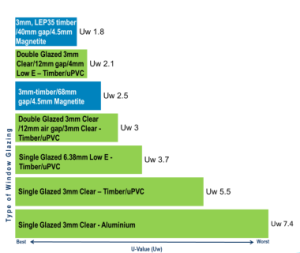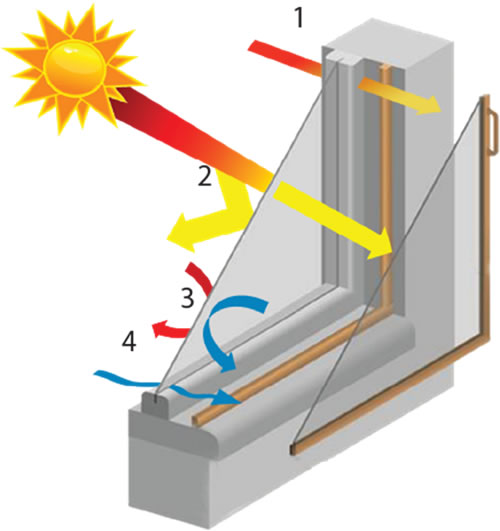
The Window Energy Rating System (WERS) was developed by the Australian Window Association (AWA) in conjunction with the CSIRO and Unisearch Ltd. WERS brought Australia in line with international standards, in 2008. The ratings compare windows, based on performance. The ratings listed in the chart below combine several key performance criteria.
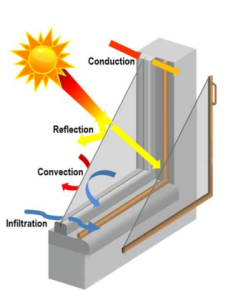
U – Value (Uw) represents heat transfer through a window, irrespective of direct sunlight. The U-value is specific to windows, though it is the inverse of R-value, commonly used to gauge wall or ceiling insulation and other building materials. For this reason, the lower the U-Value the better the insulation performance. Magnetite uses acrylic glazing rather than low-E glass to minimise the U-value. Acrylic glazing is up to six times more thermally efficient than glass.
Solar Heat Gain Coefficient (SHGC) measures the solar energy that travels through glazing. The lower the SHGC, the less solar heat is transmitted through the window. In hot weather climates, windows with a low SHGC are preferred, to minimise unwanted solar heat gain. In cold weather climates, windows with high SHGC are preferred to allow solar heat gain. In most climates the orientation of the window will determine the requirements for SHGC. Typically, West-facing windows should have a darker shade providing a lower SHGC compared to South windows, which should be clear. North or East facing windows have varying SHGC’s, based on building design and climate zone. Magnetite has a range of solar control films, (Solartite) to reduce the SHGC and minimise radiant heat before it enters the air cavity, delivering better results.
Visible transmittance (VT) measures the amount of light a window lets through. A higher VT means more light is transmitted. A higher VT can improve energy efficiency, as less artificial lighting is required (unless glare reduction is a consideration). Tinted glass, used to reduce solar heat gain, can also reduce the amount of visible light transmitted, which is not good for day lighting. A spectrally selective tint can help reduce the solar gain while providing as much visible light as clear glass.
Air infiltration (or leakage) measures the rate at which air passes through joints and seals in a window; the lower the air infiltration, the better a window’s energy performance. Magnetite’ has continuous magnetic seals, to limit the air infiltration from the existing window, virtually eliminating draughts. The addition of Magnetite panels will dramatically drop the air infiltration of an existing window from the standard 5.0L/m2 to 0.5L/m2, a tenfold reduction in air infiltration thanks to magnetic seals.